Seasonal ARIMA models
BUS 323 Forecasting and Risk Analysis
Seasonal ARIMA models
- Non-seasonal component defined by \((p,d,q)\).
- Seasonal component defined by \((P,D,Q)_{m}\).
\(m\): seasonal period *e.g. ARIMA(1,1,1)(1,1,1)\(_{4}\):
AR(1), MA(1), first differencing, quarterly data
\[ y_{t}' = c + \phi_{1} y_{t-1}' + \Phi_{1} y_{t-4}' + \theta_{1} \epsilon_{t-1} + \Theta_{1} \epsilon_{t-4}' + \epsilon_{t} \]
Example: seasonal employment
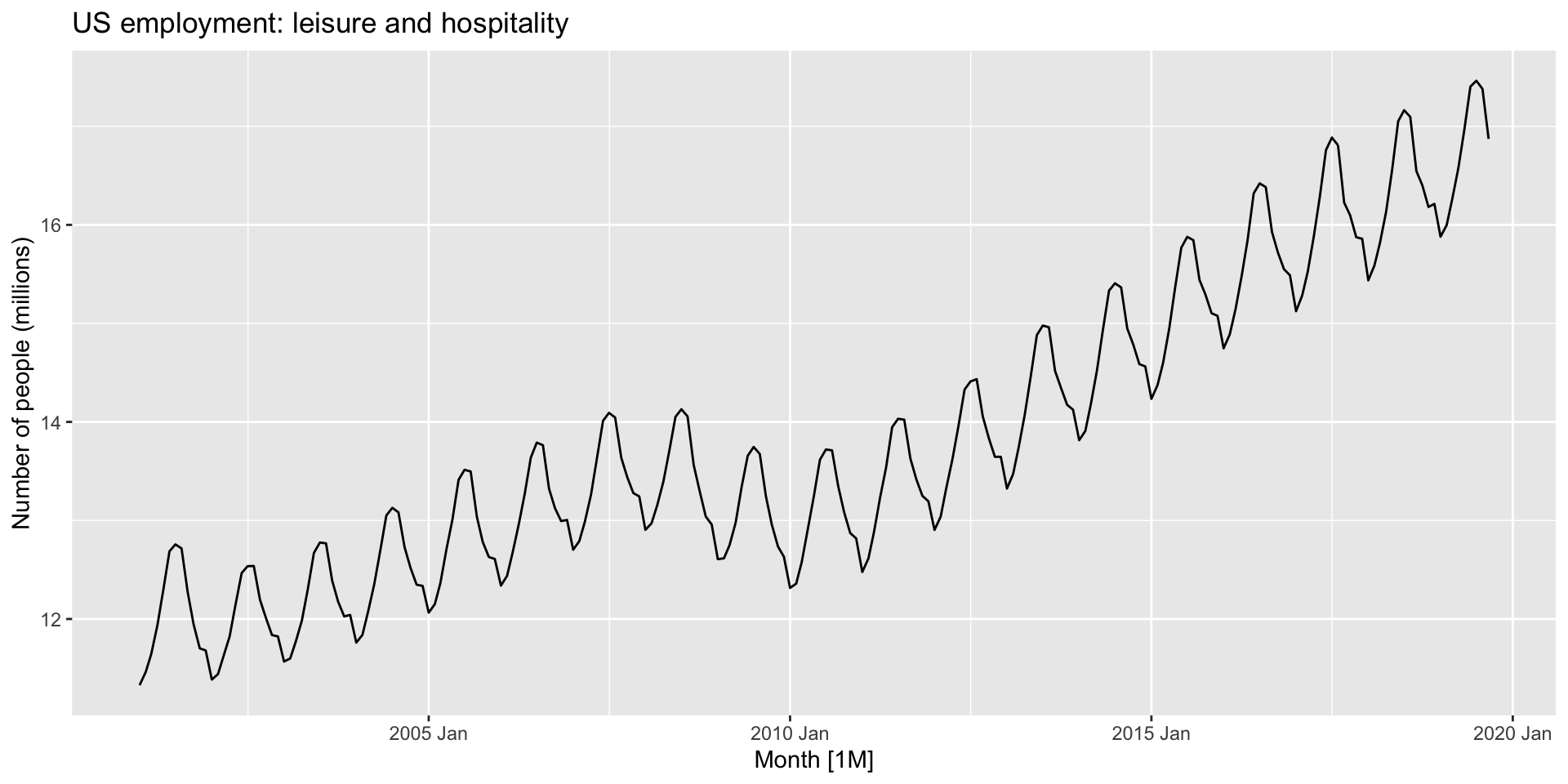
- Monthly leisure and hospitality employment in the US
- Use
us_employmentfromfpp3. - Filter based on
Title=="Leisure and Hospitality"andyear(Month) > 2000
Example: setup
Example: time plot
Partial autocorrelation plots
- Measure correlation between \(y_{t}\) and \(y_{t-k}\) after removing the effects of lags 1, 2, 3, …, \(k-1\).
- \(\alpha_{k} = \phi_{k}\) in an AR(\(k\)) model.
PACF plots in R
PACF plots in R
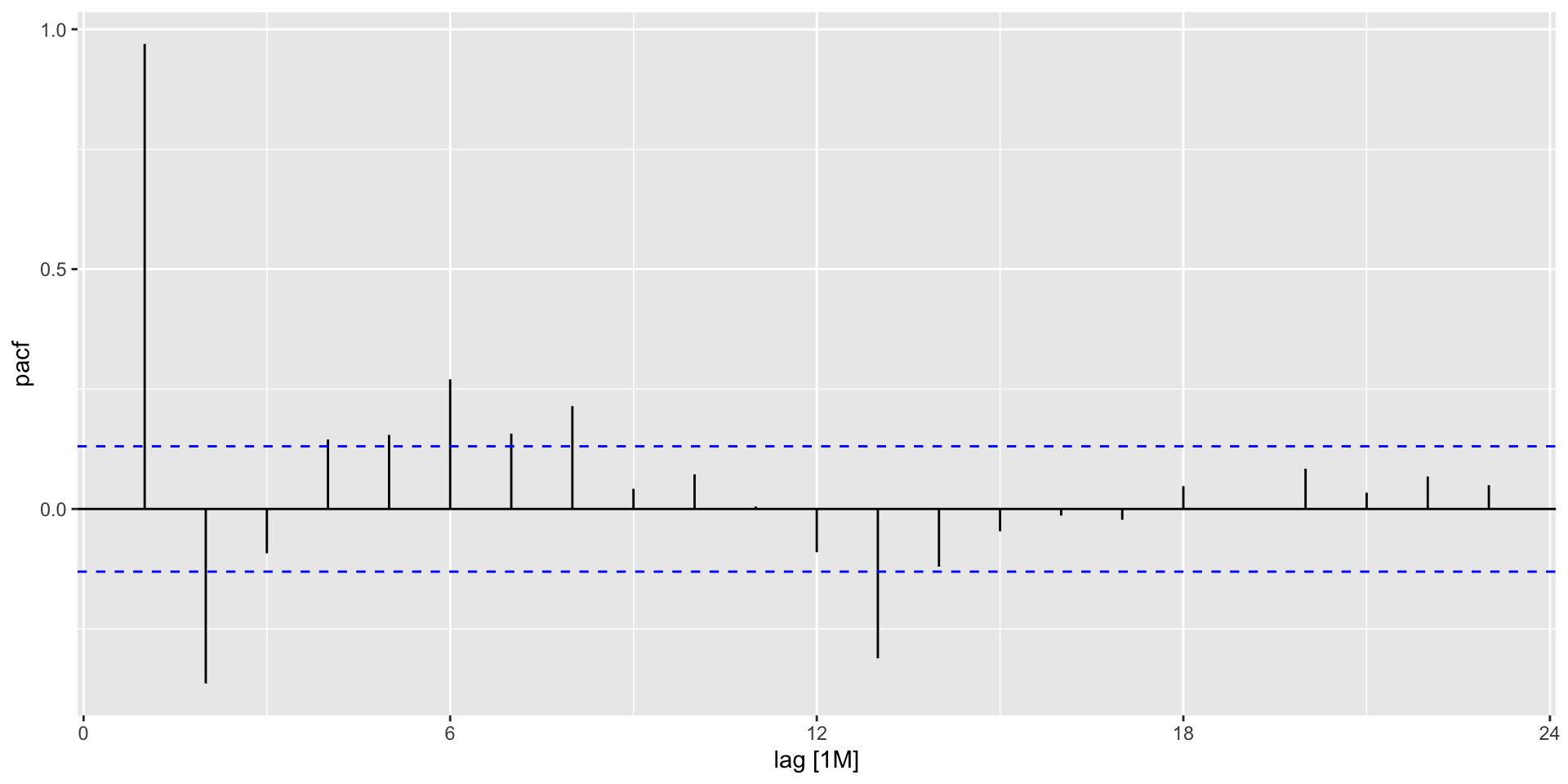
PACF plots in R
- Another option: use
gg_tsdisplay()with optionplot_type = "partial"
PACF plots: interpretation
- ARIMA(\(p,d,0\)) if with differenced data:
- ACF exponentially decaying or sinusoidal.
- Significant spike at lag \(p\) in PACF but none beyond lag \(p\).
- ARIMA(\(0,d,q\)) if with differenced data:
- PACF exponentially decaying or sinusooidal.
- Significant spike at lag \(q\) in ACF but none beyond lag \(q\).
Example: towards an ARIMA
- The data are non-stationary. What to do?
- First difference?
Example: first difference plots
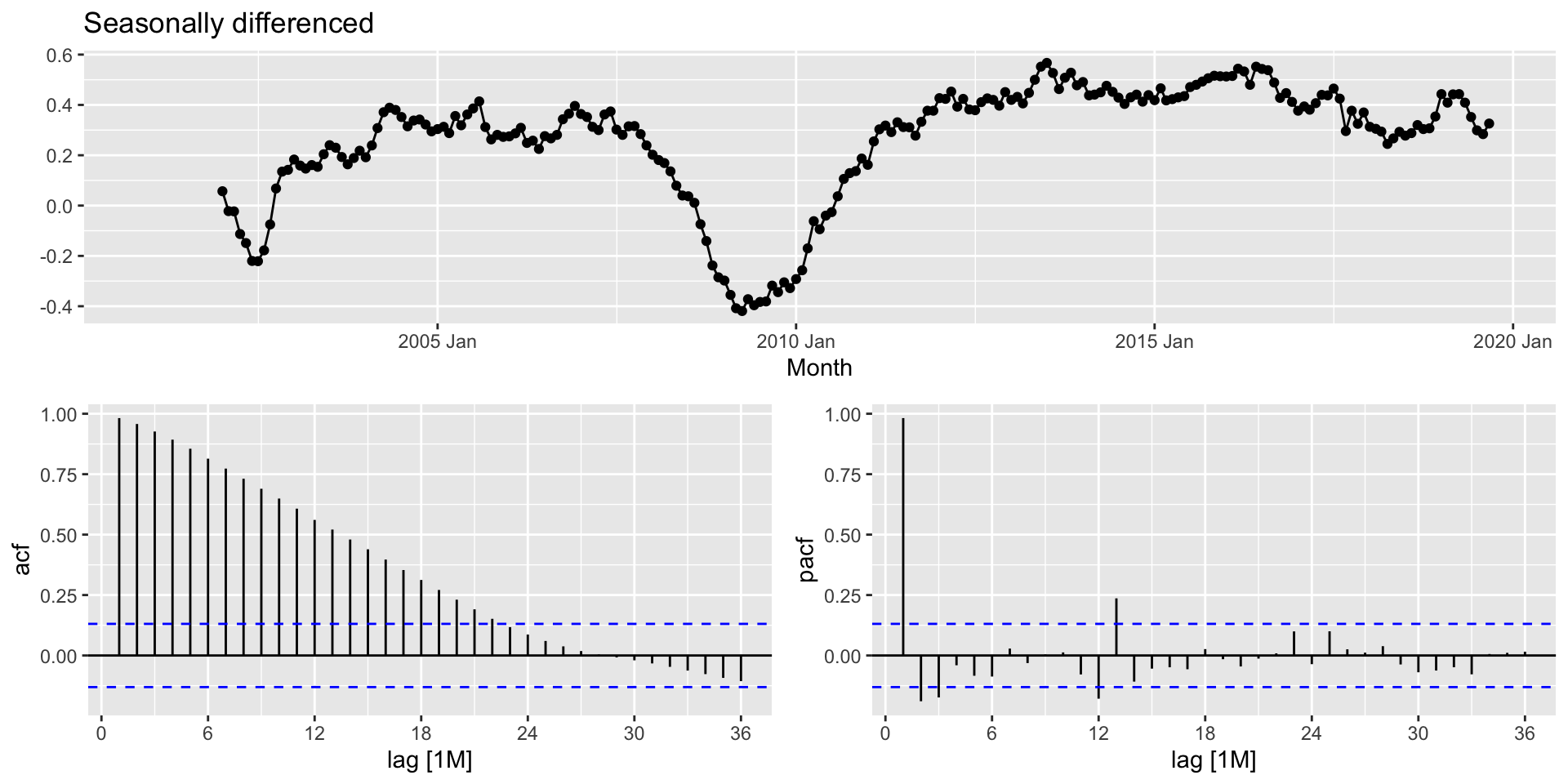
Example: towards an ARIMA, again
- Still non-stationary. Now what?
- Second difference?
Example: double-difference plots

Example: Model selection
- ACF spike at lag 2 \(\rightarrow\) non-seasonal MA(2).
- ACF spike at lag 12 \(\rightarrow\) seasonal MA(1).
- We need:
- First difference
- Seasonal difference
- Non-seasonal MA(2)
- Seasonal MA(1)
- ARIMA(0,1,2)(0,1,1)\(_{12}\)
Example: Model selection
- Or maybe…
- PACF spike at lag 2 \(\rightarrow\) non-seasonal AR(2)
- PACF spike at lag 12 \(\rightarrow\) seasonal MA(1)
- We need:
- First difference
- Seasonal difference
- Non-seasonal AR(2)
- Seasonal MA(1)
- ARIMA(2,1,0)(0,1,1)\(_{12}\)
Example: estimation
- Let’s estimate both
- Also allow for automatic selection.
fit <- leisure |>
  model(
    arima012011 = ARIMA(Employed ~ pdq(0,1,2) + PDQ(0,1,1)),
    arima210011 = ARIMA(Employed ~ pdq(2,1,0) + PDQ(0,1,1)),
    auto = ARIMA(Employed, stepwise = FALSE, approx = FALSE)
  )
fit
# A mable: 1 x 3
arima012011 arima210011 auto
<model> <model> <model>
1 <ARIMA(0,1,2)(0,1,1)[12]> <ARIMA(2,1,0)(0,1,1)[12]> <ARIMA(2,1,0)(1,1,1)[12]>Example: estimation
- In
ARIMA()options:stepwise=FALSE: use ``TRUE``` by defaultapprox=FALSE: use this by default
fit <- leisure |>
  model(
    arima012011 = ARIMA(Employed ~ pdq(0,1,2) + PDQ(0,1,1)),
    arima210011 = ARIMA(Employed ~ pdq(2,1,0) + PDQ(0,1,1)),
    auto = ARIMA(Employed, stepwise = FALSE, approx = FALSE)
  )
glance(fit)
# A tibble: 3 × 8
.model sigma2 log_lik AIC AICc BIC ar_roots ma_roots
<chr> <dbl> <dbl> <dbl> <dbl> <dbl> <list> <list>
1 arima012011 0.00146 391. -775. -775. -761. <cpl [0]> <cpl [14]>
2 arima210011 0.00145 392. -776. -776. -763. <cpl [2]> <cpl [12]>
3 auto 0.00142 395. -780. -780. -763. <cpl [14]> <cpl [12]>Example: evaluation
- Let’s look at the residuals from our best model:
Example: evaluation
- Let’s look at the residuals from our best model:

Example: portmanteau test
- One spike in the ACF is still consistent with white noise
- Let’s do a Ljung-Box test just for fun:
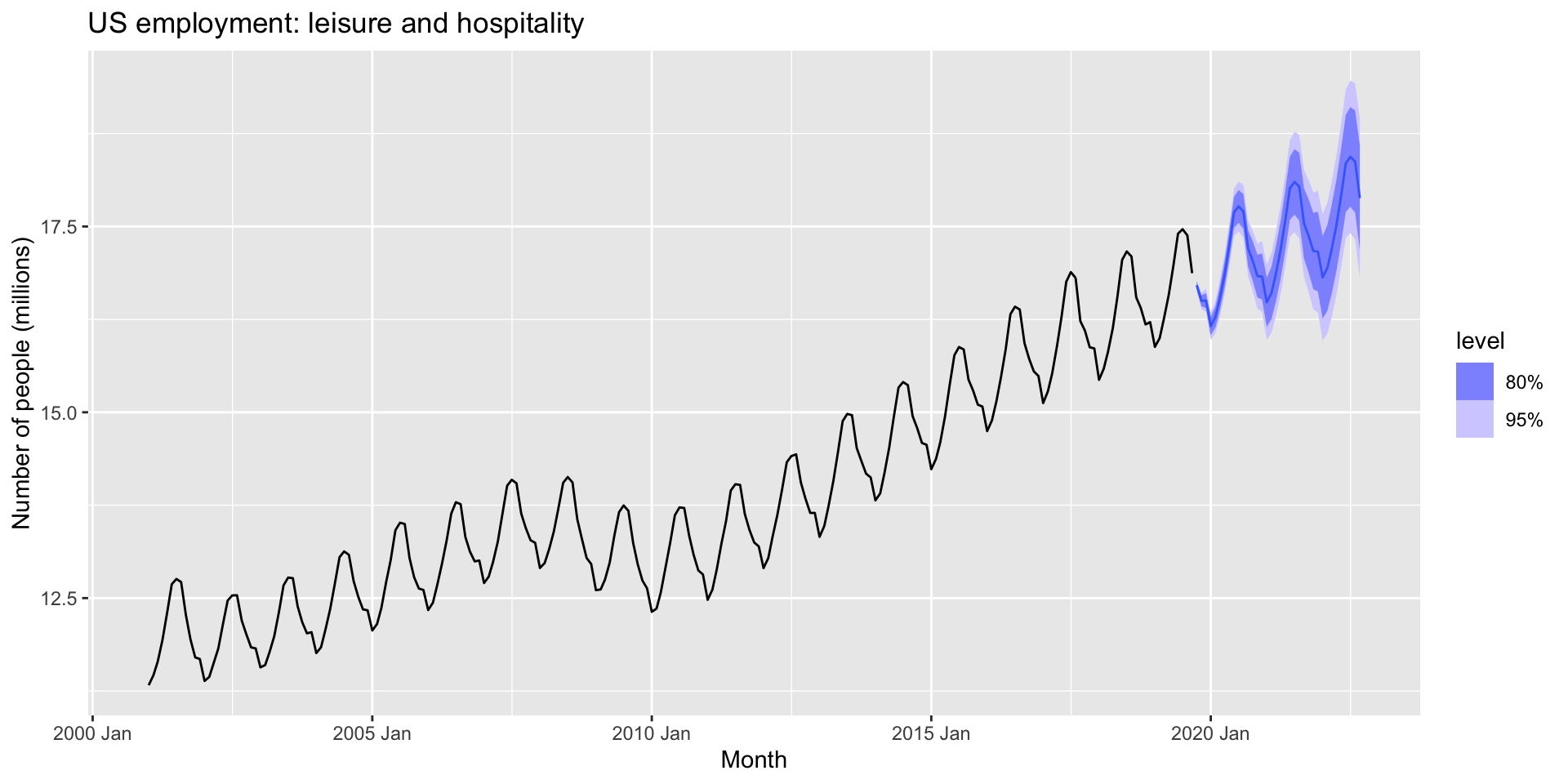
Example: forecast
- Let’s use our model to make a forecast.
Example: forecast
- Let’s use our model to make a forecast.
Example 2: drug sales
- Forecast monthly corticosteroid drug sales in Australia
- Use
PBSdataset - Filter based on
ATC2=="H02") - Note you want total monthly sales for this type of drug.
- Find a suitable ARIMA model, check that its residuals follow a white noise process, forecast 24 months into the future.